7 Signs You’re Already Living in an AI-Powered World
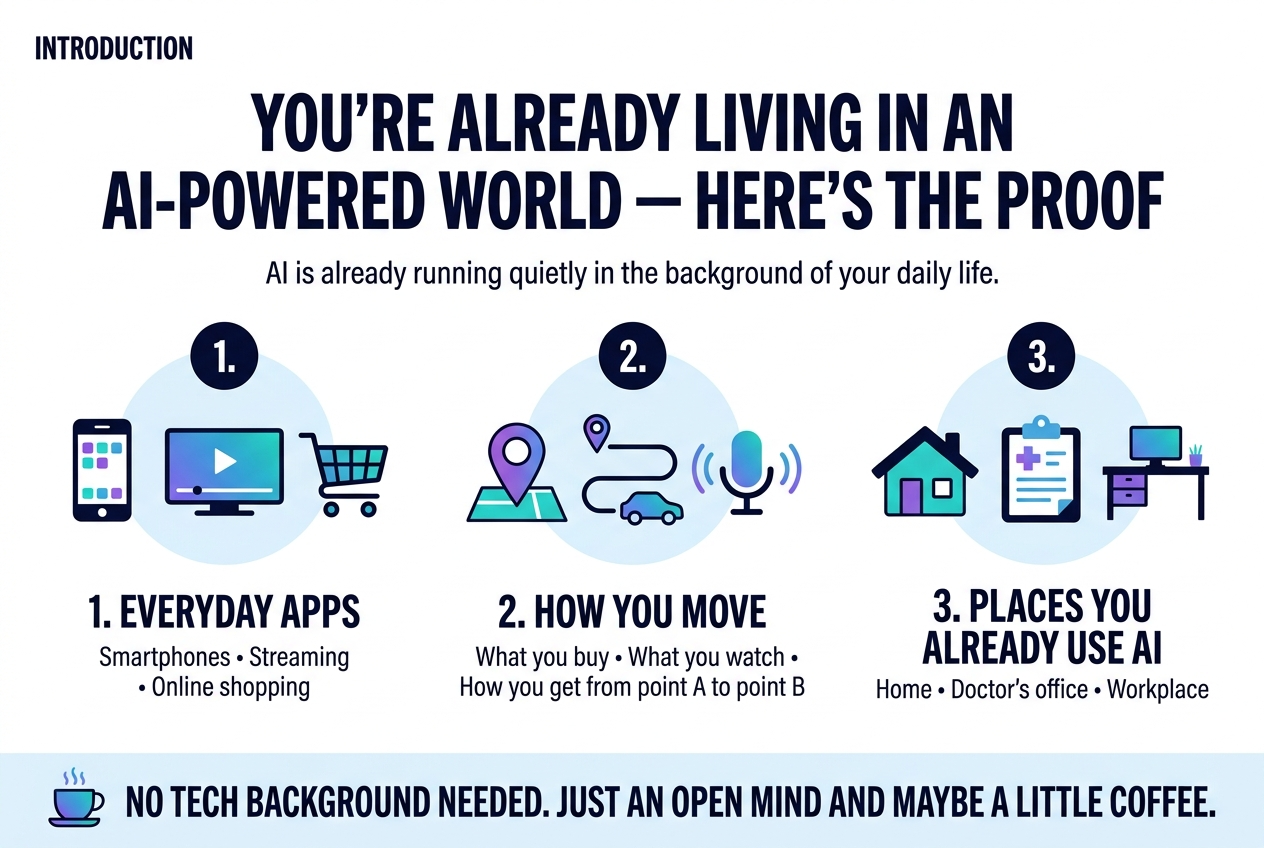
You’re Already Living in an AI-Powered World — Here’s the Proof
Most people think AI is something coming in the future. It’s not. It’s already running quietly in the background of your daily life, and you’ve probably been using it without realizing it.
This is for anyone who uses a smartphone, streams shows, shops online, or has ever asked a voice assistant what the weather is like. In other words, this is for almost everyone.
In this post, you’ll see exactly how AI is shaping what you buy, what you watch, and how you get from point A to point B. You’ll also see how your home, your doctor’s office, and your workplace are already being transformed by AI tools — most of which you’re already using right now.
No tech background needed. Just an open mind and maybe a little coffee.
Your Smartphone Is Smarter Than You Think
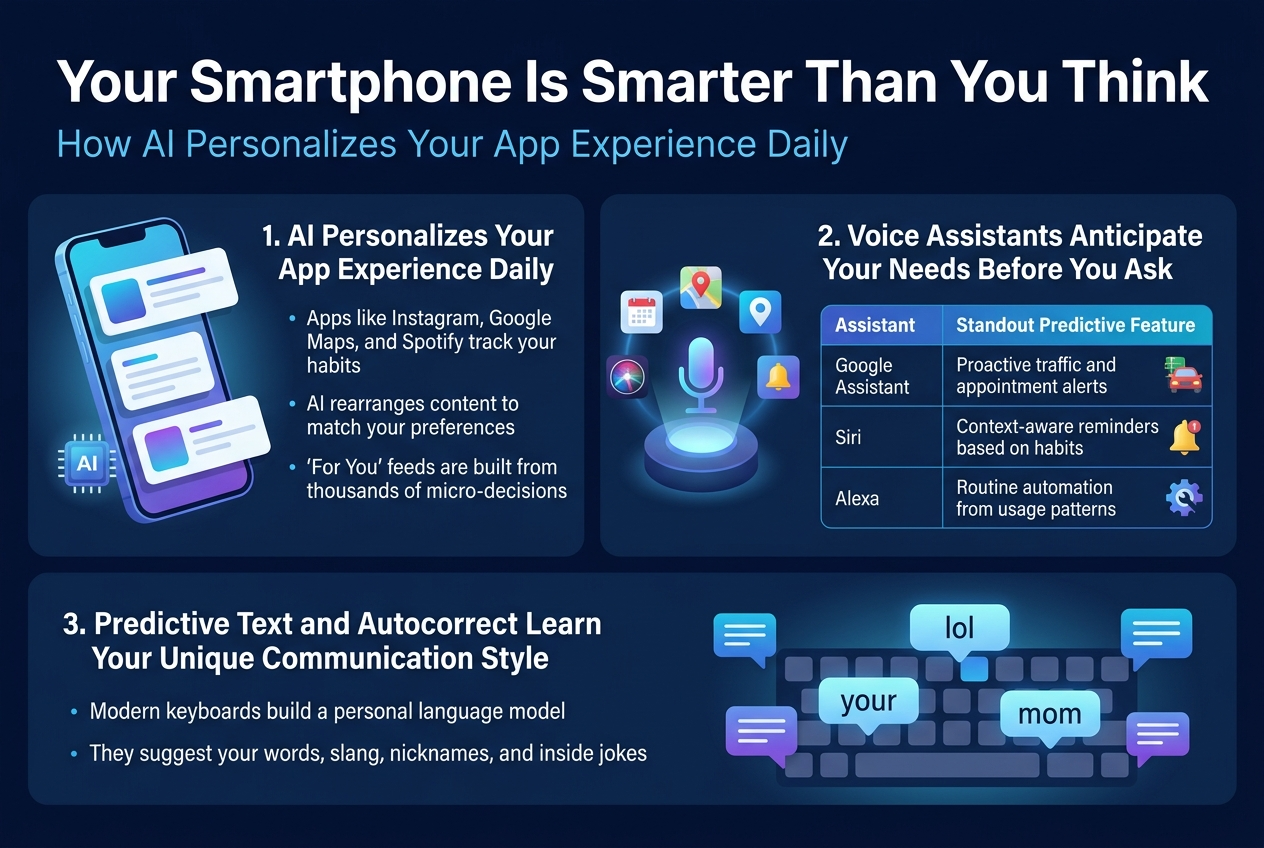
How AI Personalizes Your App Experience Daily
Your phone is quietly watching how you use it — and adapting in real time. Apps like Instagram, Google Maps, and Spotify track your habits, then rearrange content to match your preferences. That “For You” feed didn’t curate itself randomly; AI models analyzed thousands of your micro-decisions to build it.
Voice Assistants Anticipate Your Needs Before You Ask
Siri, Google Assistant, and Alexa don’t just respond — they predict. Google Assistant might suggest leaving early because traffic is unusually heavy on your regular route. Siri could remind you to call mom back without you ever setting a reminder. These systems pull from your calendar, location history, and behavioral patterns to stay one step ahead.
| Assistant | Standout Predictive Feature |
|---|---|
| Google Assistant | Proactive traffic and appointment alerts |
| Siri | Context-aware reminders based on habits |
| Alexa | Routine automation from usage patterns |
Predictive Text and Autocorrect Learn Your Unique Communication Style
Modern keyboards do far more than fix typos. They build a personal language model based on who you text, what you say, and how you phrase things. Over time, your keyboard starts suggesting your words — slang, nicknames, even inside jokes — making your texting faster and surprisingly personal.
Your Shopping Habits Are Being Shaped by AI
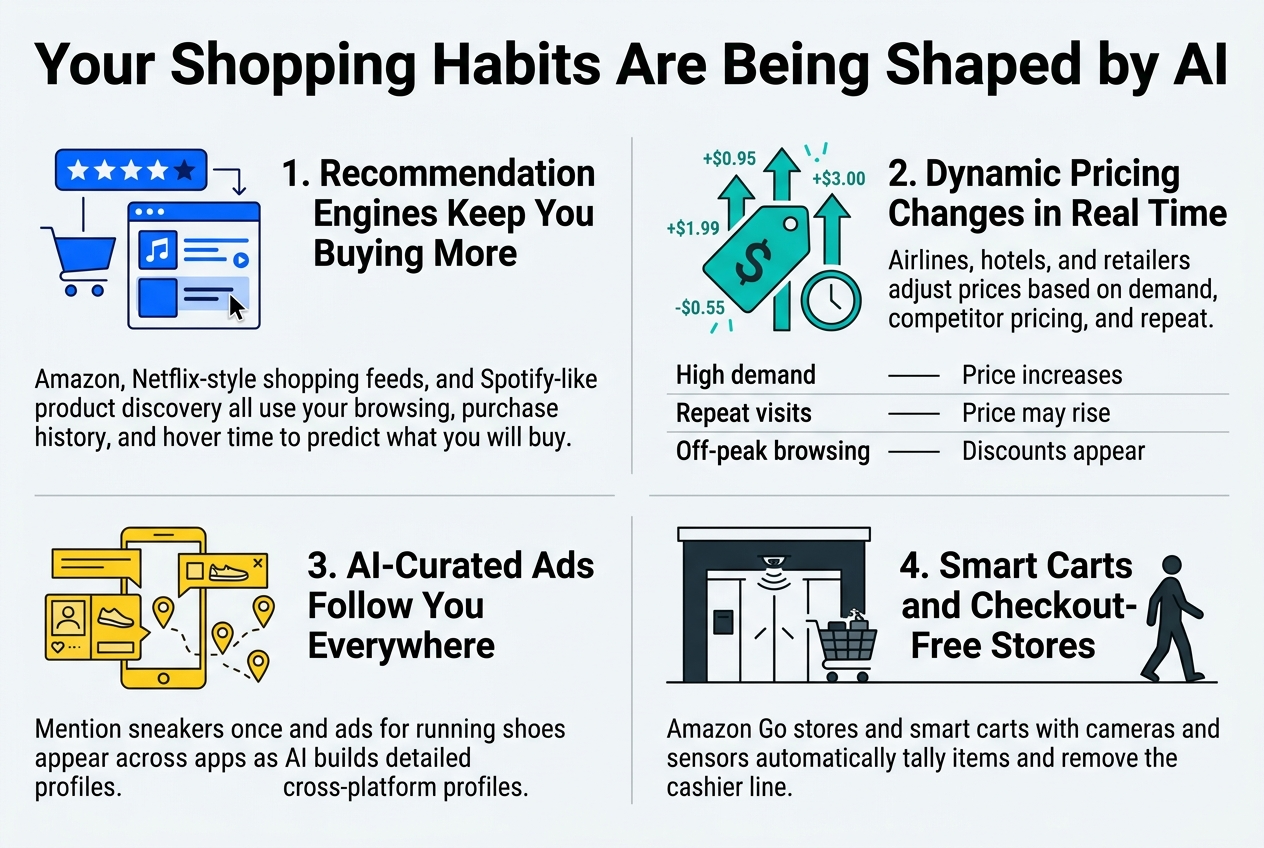
How Recommendation Engines Keep You Buying More
Amazon, Netflix-style shopping feeds, and Spotify-like product discovery all run on the same core idea — the more you browse, the better AI understands what makes you click “buy.” These engines analyze your purchase history, browsing patterns, and even how long you hover over a product to serve up eerily accurate suggestions.
Dynamic Pricing Adjusts in Real Time Based on Your Behavior
That flight you checked three times? It probably got more expensive. Airlines, hotels, and even retailers like Amazon change prices hundreds of times daily based on demand, competitor pricing, and your own search behavior.
| Factor | Impact on Price |
|---|---|
| High demand | Price increases |
| Repeat visits | Price may rise |
| Off-peak browsing | Discounts appear |
AI-Curated Ads Follow You Across Every Platform
You mention sneakers once and suddenly every app shows you running shoes. AI-powered ad networks track cross-platform behavior and build detailed profiles to serve targeted ads with unsettling precision.
Smart Carts and Checkout-Free Stores Are Already Here
Amazon Go stores let you grab items and walk out — no cashier, no line. Smart carts equipped with cameras and sensors automatically tally your items in real time, making the checkout process completely invisible.
AI Is Quietly Running Your Entertainment
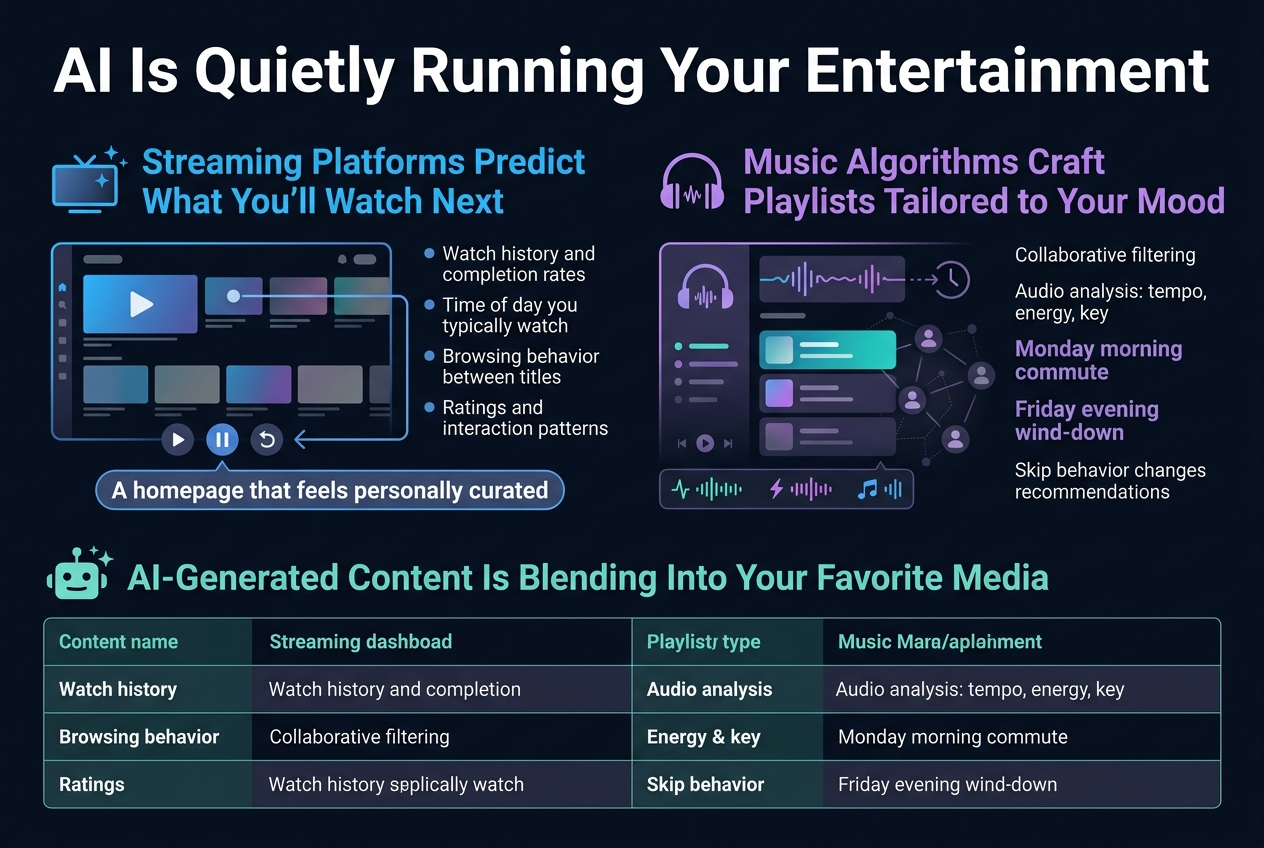
Streaming Platforms Predict What You’ll Watch Next
Netflix, Hulu, and Disney+ don’t just show you content — they study you. Every pause, rewatch, and late-night binge feeds their recommendation engines. These systems analyze:
- Watch history and completion rates
- Time of day you typically watch
- Browsing behavior between titles
- Ratings and interaction patterns
The result? A homepage that feels personally curated, because it genuinely is.
Music Algorithms Craft Playlists Tailored to Your Mood
Spotify’s Discover Weekly and Apple Music’s personalized radio aren’t random. They use collaborative filtering — matching your listening patterns against millions of similar users — alongside audio analysis that detects tempo, energy, and key. Your Monday morning commute playlist differs from your Friday evening wind-down because the algorithm actually tracks when you skip songs.
AI-Generated Content Is Blending Into Your Favorite Media
This one surprises most people. AI is already:
| Content Type | AI Role |
|---|---|
| Movie trailers | Automated editing and music sync |
| News articles | Sports and finance auto-reporting |
| Video game worlds | Procedural terrain and NPC dialogue |
| Social media videos | Auto-captioning and background generation |
You’ve likely consumed AI-assisted content today without realizing it.
Your Home Is Becoming an Intelligent Living Space
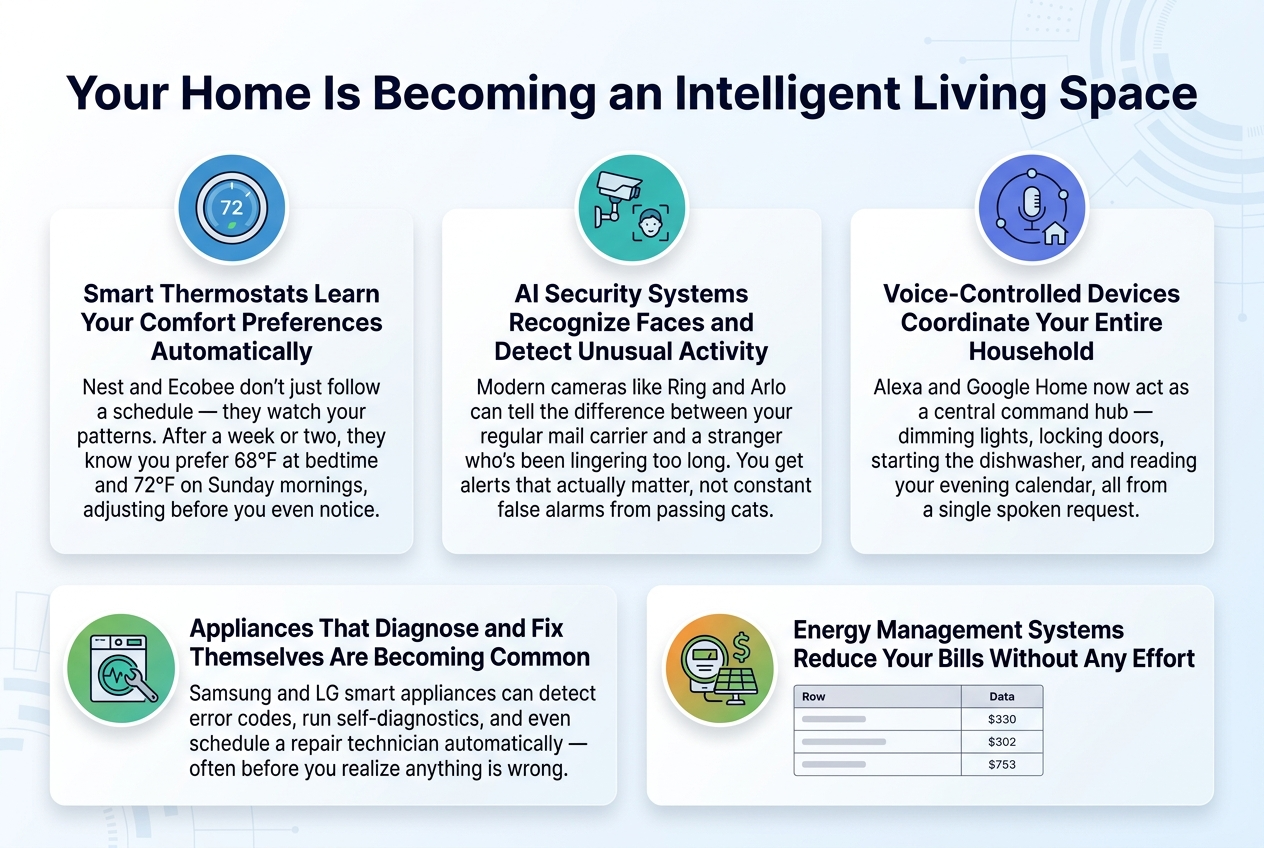
Smart Thermostats Learn Your Comfort Preferences Automatically
Nest and Ecobee don’t just follow a schedule — they watch your patterns. After a week or two, they know you prefer 68°F at bedtime and 72°F on Sunday mornings, adjusting before you even notice.
AI Security Systems Recognize Faces and Detect Unusual Activity
Modern cameras like Ring and Arlo can tell the difference between your regular mail carrier and a stranger who’s been lingering too long. You get alerts that actually matter, not constant false alarms from passing cats.
Voice-Controlled Devices Coordinate Your Entire Household
Alexa and Google Home now act as a central command hub — dimming lights, locking doors, starting the dishwasher, and reading your evening calendar, all from a single spoken request.
Appliances That Diagnose and Fix Themselves Are Becoming Common
Samsung and LG smart appliances can detect error codes, run self-diagnostics, and even schedule a repair technician automatically — often before you realize anything is wrong.
Energy Management Systems Reduce Your Bills Without Any Effort
| Feature | Benefit |
|---|---|
| Peak-hour shifting | Runs appliances during cheap-rate windows |
| Solar integration | Prioritizes stored energy smartly |
| Usage reporting | Spots energy-wasting habits instantly |
Healthcare Decisions Are Increasingly AI-Assisted
Wearables Monitor Your Vitals and Flag Health Risks Early
Your smartwatch isn’t just counting steps anymore. Devices like the Apple Watch and Fitbit now track heart rate variability, blood oxygen levels, sleep patterns, and even detect irregular heart rhythms that could signal atrial fibrillation — often before you feel a single symptom.
AI Diagnostic Tools Help Doctors Catch Diseases Faster
Radiologists now work alongside AI systems that scan medical images for early-stage tumors, diabetic retinopathy, and bone fractures with striking accuracy. Google’s DeepMind has built models that detect over 50 eye diseases from retinal scans as reliably as specialist doctors. This means faster diagnoses and fewer cases slipping through the cracks.
Personalized Treatment Plans Are Powered by Machine Learning
Gone are the days of one-size-fits-all medicine. AI platforms now analyze:
- Genetic data to predict how your body responds to specific drugs
- Medical history patterns to recommend targeted therapies
- Real-time vitals to adjust treatment on the fly
| Traditional Medicine | AI-Assisted Medicine |
|---|---|
| General treatment protocols | Personalized patient profiles |
| Reactive care | Predictive intervention |
| Slow trial-and-error | Data-driven precision |
Cancer treatment centers like MD Anderson already use AI to match patients with clinical trials tailored specifically to their tumor’s genetic makeup.
Your Workplace Is Being Transformed by AI Tools
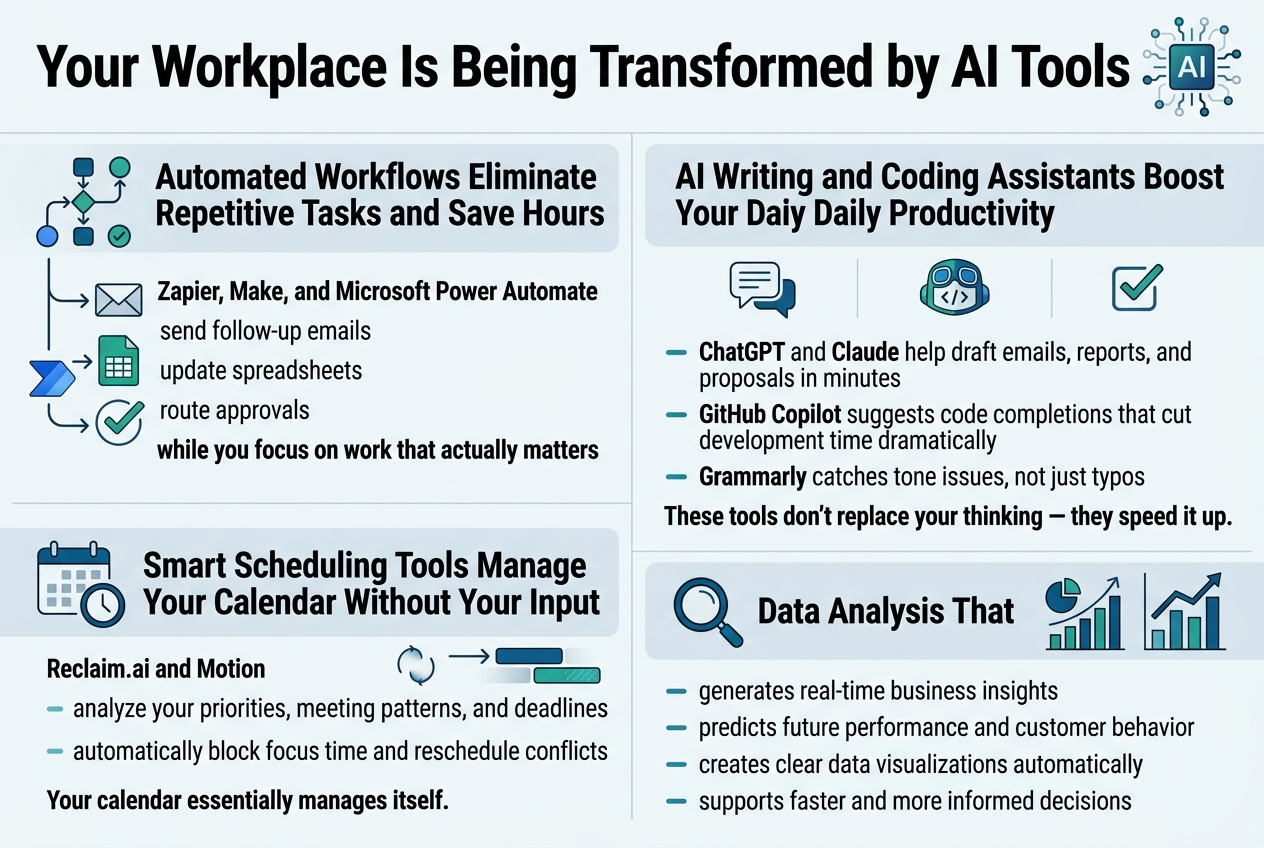
Automated Workflows Eliminate Repetitive Tasks and Save Hours
Tools like Zapier, Make, and Microsoft Power Automate quietly handle the boring stuff — sending follow-up emails, updating spreadsheets, routing approvals — while you focus on work that actually matters.
AI Writing and Coding Assistants Boost Your Daily Productivity
- ChatGPT and Claude help draft emails, reports, and proposals in minutes
- GitHub Copilot suggests code completions that cut development time dramatically
- Grammarly catches tone issues, not just typos
These tools don’t replace your thinking — they speed it up.
Smart Scheduling Tools Manage Your Calendar Without Your Input
Apps like Reclaim.ai and Motion analyze your priorities, meeting patterns, and deadlines to automatically block focus time and reschedule conflicts. Your calendar essentially manages itself.
Data Analysis That Once Took Days Now Happens in Seconds
| Old Way | AI-Powered Way |
|---|---|
| Manual spreadsheet sorting | Instant pattern recognition |
| Hiring an analyst | Tools like Tableau AI or Power BI |
| Weekly reports | Real-time dashboards |
| Days of data cleaning | Automated data prep |
Business decisions that used to wait on a quarterly review now get made on the spot — with accurate, up-to-date insights backing them up.
Transportation and Navigation Rely on AI Every Day
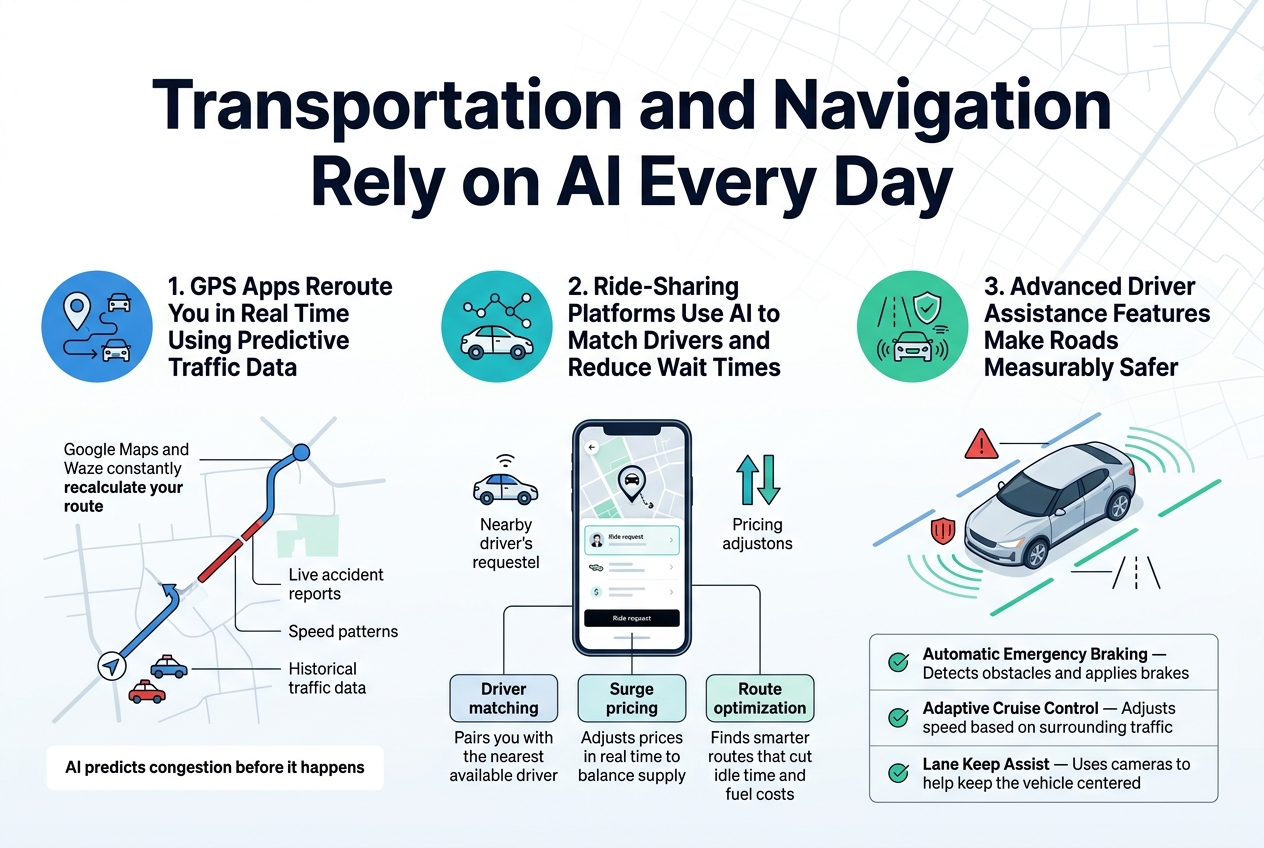
GPS Apps Reroute You in Real Time Using Predictive Traffic Data
Google Maps and Waze don’t just show you a route — they constantly recalculate it based on live accident reports, speed patterns, and historical traffic data. AI predicts congestion before it happens, often rerouting you minutes ahead of a slowdown you’d never see coming.
Ride-Sharing Platforms Use AI to Match Drivers and Reduce Wait Times
When you tap “Request Ride,” AI is doing heavy lifting behind the scenes:
- Driver matching — algorithms pair you with the nearest available driver based on location, direction, and estimated pickup time
- Surge pricing — demand forecasting adjusts prices in real time to balance supply
- Route optimization — drivers get smarter routes that cut idle time and fuel costs
Advanced Driver Assistance Features Make Roads Measurably Safer
Modern vehicles are rolling AI platforms. Features powered by machine learning include:
| Feature | What It Does |
|---|---|
| Automatic Emergency Braking | Detects obstacles and brakes faster than human reaction |
| Lane-Keeping Assist | Corrects drift using camera and sensor data |
| Adaptive Cruise Control | Adjusts speed based on surrounding traffic flow |
These systems have already reduced rear-end collisions by up to 50% in equipped vehicles — a quiet but massive safety win.
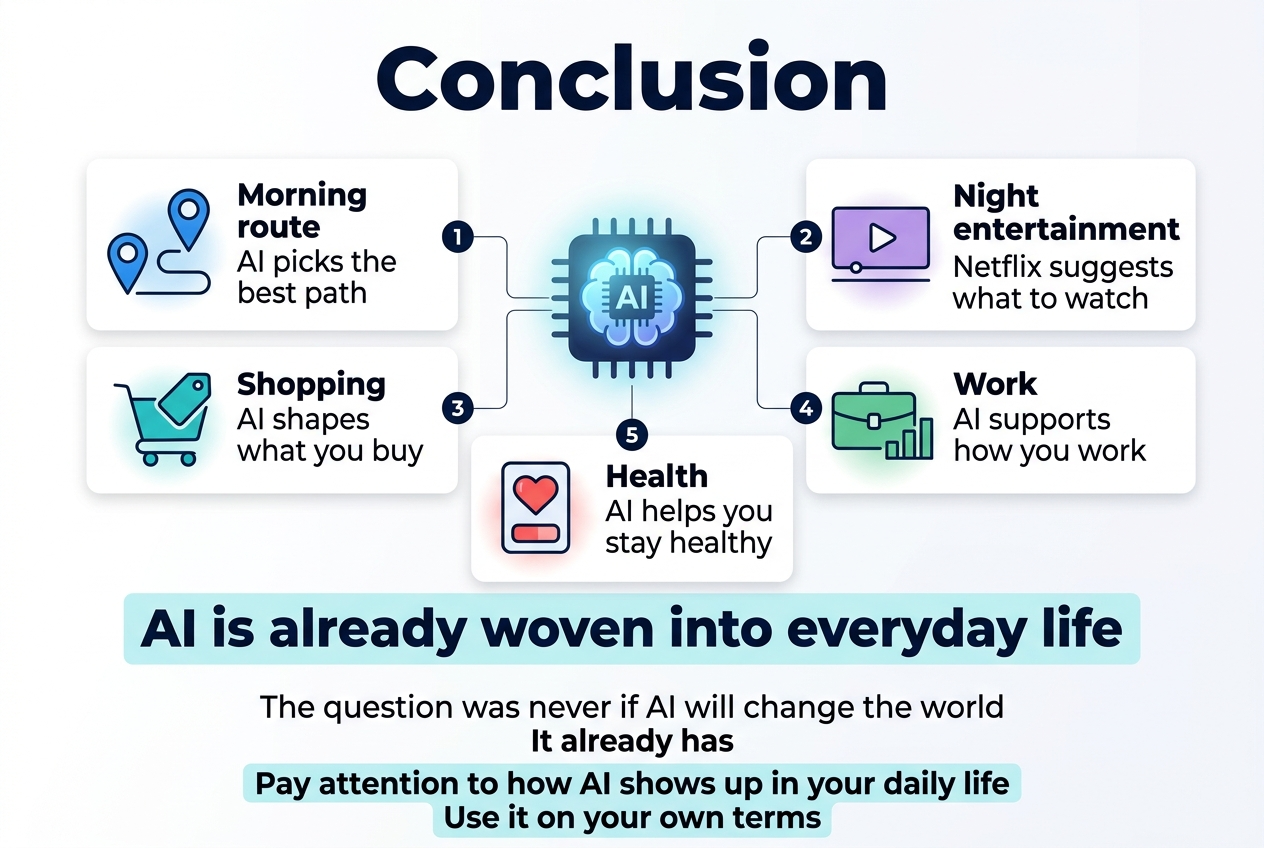
AI isn’t some distant, futuristic concept anymore — it’s already woven into the everyday moments you barely think twice about. From the route your GPS picks in the morning to the show Netflix suggests at night, artificial intelligence is quietly working behind the scenes in ways that genuinely shape how you live, work, shop, and stay healthy.
The question was never really “will AI change our world?” It already has. The smarter move now is to pay attention to how it’s showing up in your daily life, so you can make the most of it rather than just go along for the ride. The more aware you are of these tools, the better equipped you’ll be to use them on your own terms.