Okay, picture this. My cousin — bless her — walked into a Toyota dealer last spring with, honestly, no numbers in her head at all. She wanted a RAV4. Blue. That was it. That was the whole plan, right?
Three hours later? She was signing papers. For a trim she did not need. With add-ons she never asked for. And a monthly payment $87 higher than the one she actually wanted. Ugh.
I don’t blame her, not one bit. Car buying is — I swear — designed to wear you down. The lot is loud, the numbers come at you fast, and every single question feels like it has a catch tucked behind it. Which is exactly, I mean exactly, why doing this with AI first works so well. You do the hard thinking at your kitchen table. In your own time. In your pajamas if you want. Before anyone starts talking about “today only” pricing.
I’ve used ChatGPT for this twice now. Once for myself, once for my cousin on her second try (yes, second — the first one did not go well, as you just read). It did not buy the car, obviously. It just meant we walked in knowing a fair price, knowing which fees were total nonsense, and knowing what to say when the pressure ramped up. She saved real money. Not because the AI is magic — it isn’t — but because she stopped guessing. Simple as that.
TL;DR: AI car buying means using a chatbot and free pricing sites to compare models, check fair prices, decode dealer fees, and draft negotiation messages before you visit a lot. Do the research at home, paste real quotes into the AI, and walk in with a target price and a walk-away number.
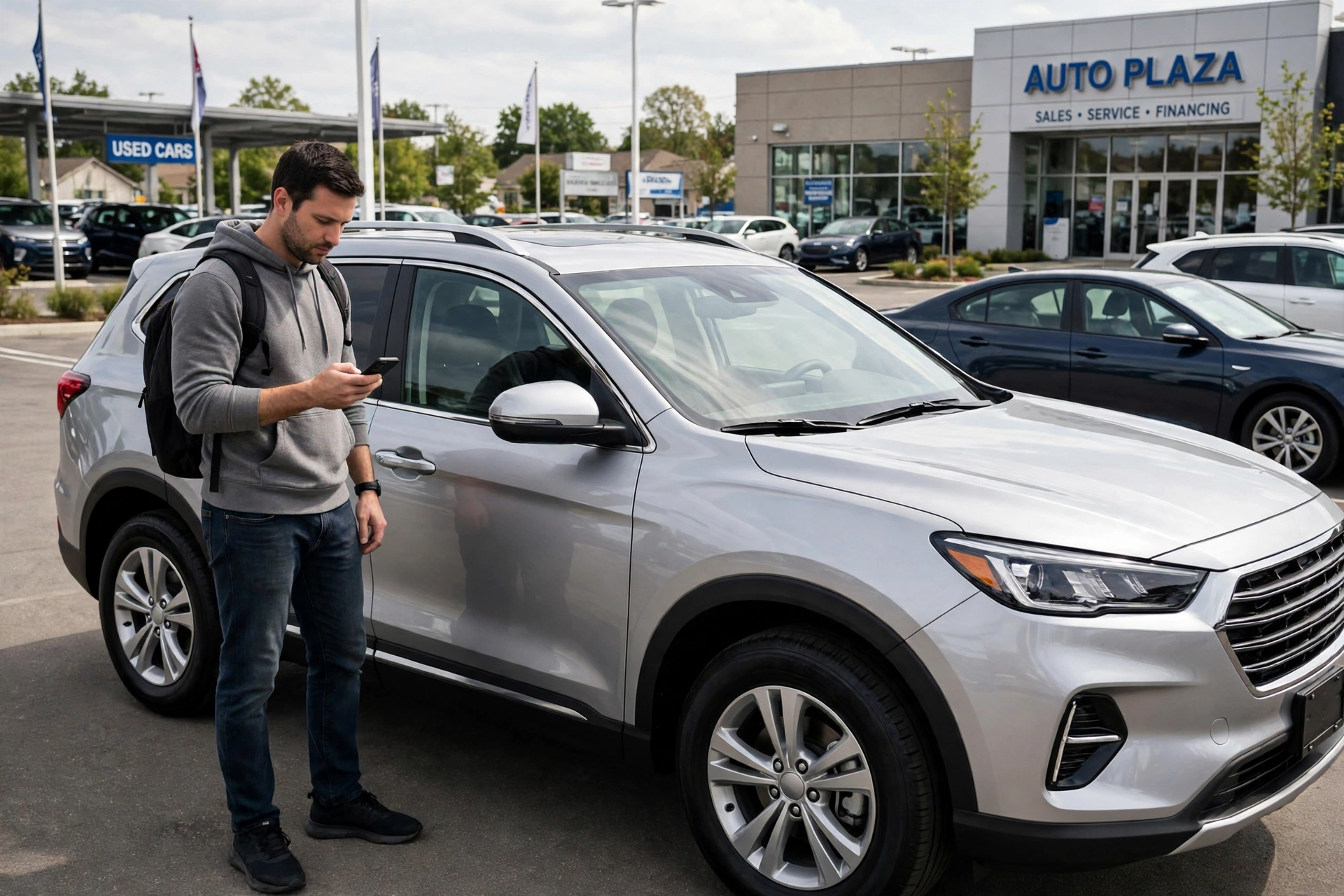
What is AI car buying?
So, what is AI car buying, really? It’s using chatbots and pricing tools to compare models, check fair prices, and draft negotiation messages before you ever talk to a dealer. It does not buy the car for you — no, it doesn’t do that part — it just means you arrive knowing the numbers instead of guessing under pressure. Which, trust me, changes everything.
And the stakes? High. Really high. Kelley Blue Book reported the average new-vehicle transaction price in the US hit $50,080 in September 2025 — the first time it ever crossed $50,000, which is wild when you think about it — and Cox Automotive data put December 2025 at a new record of $50,326. Average incentive spending that September was about 7.4% of the price, roughly $3,700. A CarGurus study found 90% of buyers researched vehicles online before buying, up from 81% the year before. So yeah, almost everyone is researching first. You should too.
The tools I actually use
Keep this simple, please. You need a chatbot and two or three pricing sites. That’s it. That’s the whole toolkit, I promise.
| Tool | Price | Best For |
|---|---|---|
| ChatGPT | Free ($20/month for Plus) | Writing prompts, comparing trims, drafting messages |
| Kelley Blue Book | Free | Fair market price ranges |
| Edmunds | Free | True market value and owner reviews |
| CarGurus | Free | Live listings with deal ratings |
| TrueCar | Free | Upfront pricing from local dealers |
Start with the free versions — I did, and I’ve done this whole process without paying for anything, not a cent. They also pair well with my ChatGPT budgeting prompts, since, well, a car payment is just one more budget line, isn’t it?
1. Narrow it down before you fall in love
Most people pick a car, then try to justify it afterwards. Flip that around. Seriously, flip it.
Prompt: “I drive about 40 miles a day, mostly highway. I need room for two car seats and a stroller. My total budget is $32,000 out the door, and I want good gas mileage and low maintenance costs. Give me 4 models that fit, with one honest downside for each.”
Ask for the downside every single time. Without it, the AI just hands you a brochure — shiny, useless. With it, you get stuff like “the third row is basically decorative” or “insurance runs high on this one.” Hmm, useful, right? My cousin’s first list had a three-row SUV she loved in photos. Loved it! One downside line killed it, though: she didn’t need the third row, and she’d pay for it for six years. Six years! No thanks.
2. Ask what the car really costs over 5 years
The sticker price? That’s the smallest part of the story. Honestly. Insurance, gas, tires, maintenance — they add up fast, and they vary a lot between models that look, you know, pretty similar on the lot.
Prompt: “Compare a 2025 Honda CR-V, Toyota RAV4, and Mazda CX-5 over 5 years. Estimate insurance, fuel at 12,000 miles a year, and routine maintenance. Show me a simple total for each, and tell me where your estimates could be off.”
That last line matters. A lot. It forces the AI to admit — okay, fine — that insurance in Ohio is not insurance in Florida. Not even close. A $40-a-month difference is $2,400 over five years. Do the math on that for a second. Yeah.
3. Check the fair price, not the asking price
Here’s the prompt I use on every listing now. Every one. No exceptions.
Prompt: “This dealer lists a 2024 Honda Civic EX for $26,900 with 18,000 miles. Kelley Blue Book’s fair market range is [paste the range]. Is this a good, fair, or high price? What would a reasonable offer be, and what should I check on this specific car?”
Paste the real KBB range yourself. Don’t let the chatbot guess it — it will guess, and it will guess wrong, trust me on this. When I did this for a used Camry last year, the AI flagged the listing as about $1,200 above the fair range, and noted the trim lacked the safety package the ad implied. Sneaky, right?
4. Make it decode the dealer quote
This is my favorite prompt. My absolute favorite, because dealer quotes are written to confuse you. Like, on purpose? Probably.
Prompt: “Here is my out-the-door quote: [paste the full quote]. List every fee, explain which ones are normal in my state, and flag any fee that looks padded or duplicated. Then rewrite the quote as one clean total.”
Doc fees, title fees, taxes — real. Nitrogen-filled tires for $199? Paint protection you didn’t ask for? A second “dealer prep” charge? Often not real. Or, well, real in the sense they printed it, but not something you should pay. When my cousin pasted her second quote, the AI spotted a $699 bundle she had already declined. Already declined! She pointed at that line — just pointed, calmly — and it came off. Poof.

5. Draft the negotiation email for you
A lot of people hate haggling face to face. I get it. I do too, sometimes. Good news: you don’t have to start there.
Prompt: “Write a short, polite email to a dealer. I’m interested in stock number [X] at $27,500 out the door, based on comparable listings. I’m ready to buy this week if we agree on price, and I have financing arranged. Keep it under 120 words and don’t sound desperate.”
Send that same email to three dealers. Three! The first one who knows you’re talking to two others suddenly finds room they didn’t have yesterday. Funny how that works, huh? The same calm approach works for pay talks too, as in my ChatGPT salary negotiation prompts.
6. Get a reality check on your trade-in
Trade-ins. Oh boy. That’s where dealers quietly make money back. Get a number before you go — before, not after.
Prompt: “My 2019 Honda Accord LX has 68,000 miles, clean title, one small dent on the rear bumper, and new tires. What is a realistic private-party value and trade-in value? What should I fix before selling, and what isn’t worth fixing?”
Usually the answer is: don’t fix much. Seriously, don’t. A $500 bumper repair rarely adds $500 to the offer — I know, it feels backwards, but there it is. Knowing both numbers, though, lets you spot a lowball instantly. Offered $2,000 under range? Sell privately. Or walk. Your call, but don’t take that offer.
7. Run the loan math before you sign
This one saves people from the most expensive mistake in car buying: shopping by monthly payment alone. Just the monthly payment. That’s it, that’s the trap.
Prompt: “Compare a $28,000 loan at 6.5% for 60 months versus 72 months. Show the monthly payment and total interest for each. Then tell me what that extra year actually costs.”
The 72-month payment looks friendlier. The total interest does not. Not at all. On those numbers, the longer loan costs roughly $1,000 more in interest. I’m not saying never take 72 months — sometimes it’s the only way, I get that — just choose it with your eyes open, okay? The same get-the-numbers-first habit helped me cut my grocery bill too.
Where AI gets it wrong
I should be straight about this. AI car buying has limits, and they matter. They really do.
Prices go stale. Fast. A chatbot does not know the dealer down the road dropped a price yesterday, so cross-check live listings on CarGurus or Edmunds before quoting a number. It can also invent trim details — yes, invent them, out of thin air — so verify features on the manufacturer’s site. Treat it as a fast research assistant, not a source of truth. And never, ever tell the dealer “the AI said so.” Say “comparable listings here are at $X.” That’s a fact they have to answer. See the difference?
FAQ
Not directly, and honestly you wouldn’t want it to. It can draft messages, compare offers, and flag bad fees, but the actual negotiation still happens between you and the dealer. Use it to prepare, then send the messages yourself.
Sometimes, but not reliably — I wish they were, but no. Its prices can be months out of date. Use it for comparisons and drafts, and get actual prices from Kelley Blue Book, Edmunds, or live dealer listings before you make an offer.
No need. Really, no need at all. Dealers respond to competing offers and real market data, not to how you found them. Quote comparable listings and your target out-the-door price instead.
Yes, and it matters even more there — way more, actually. Used prices vary wildly by mileage, condition, and history. Paste the exact listing and the vehicle history into your prompts, and always get an independent inspection before buying. Always.
Spend 30 minutes at home tonight with the first prompt. Just 30 minutes. You’ll walk into the dealership knowing your budget, your target price, and the fees to refuse. That’s not a trick. It’s just homework, done before the pressure starts — homework, not magic. And if you want a broader money-saving habit to go with it, the best free AI tools roundup is a good next read, and my Black Friday deals guide uses the same compare-first approach for holiday shopping.
Save hours every week with AI
One practical tip every Tuesday — the AI tools, prompts, and workflows that actually save you time. Free, no fluff.
No spam. Unsubscribe anytime.